






Picture a street-food vendor who’s worked 40 years and has nothing saved for old age — no employer, no pension, no safety net. She’s not unusual: most of the world’s workers earn their living informally, outside any retirement system. One of the most promising answers is micro-pensions for informal workers: small, flexible retirement savings schemes designed for people with irregular incomes and no employer. From Nigeria’s POS-terminal pensions to Jamaica’s rethink of state provision, 2026 has been a revealing year for the idea. Here’s how micro-pensions work, where they’re being tried, and why getting people to sign up is so stubbornly hard.

What Micro-Pensions for Informal Workers Actually Are
Strip away the jargon and a micro-pension is beautifully simple: a long-term savings pot you contribute to in tiny, irregular amounts — whatever you can spare, whenever you earn it. Unlike formal pensions tied to monthly salaries, micro-pensions accept the reality of informal work: income arrives in lumps, seasons, and dry spells. Good designs share three features. Contributions are flexible, with no fixed monthly debit that fails when earnings dip. Part of the pot is usually accessible for emergencies, because nobody locks money away for 30 years when next month is uncertain. And enrolment happens through agents people already trust — market associations, cooperatives, mobile-money shops — not distant pension offices. The goal isn’t to replicate rich-country pensions; it’s to give informal workers something formal workers take for granted: a future.
Nigeria: Pensions at the POS Terminal
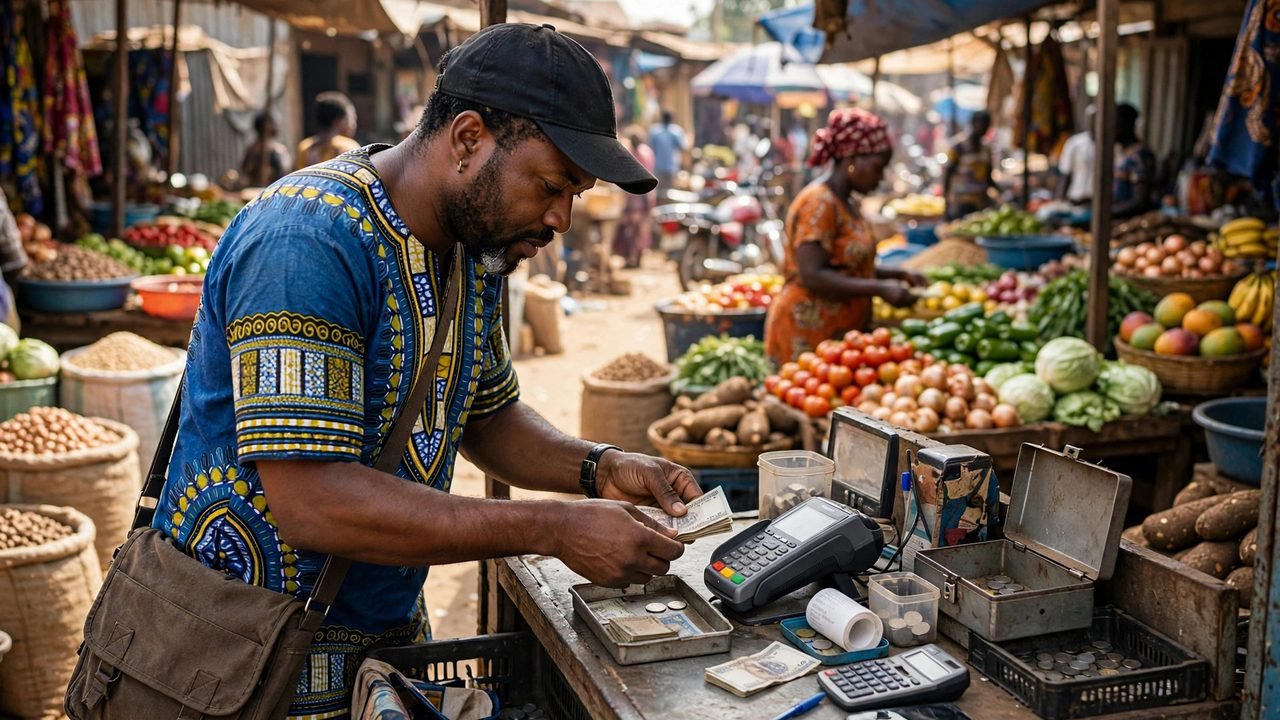
Nigeria shows both the scale of the problem and the creativity of the response. Around 75 million Nigerians work informally, yet fewer than 100,000 were enrolled in any pension arrangement — a staggering gap. In February 2026, the pension regulator PenCom partnered with the fintech Awabah to let informal workers open a Personal Pension Plan right at local POS terminals — the same small shops where people already top up phones and transfer money. Contributions start from just N500 (well under a dollar). The design is clever: 40% of savings sit in a contingent pot accessible for emergencies after three months, while 60% stays locked for retirement. That split directly attacks the biggest objection informal workers have — “what if I need the money?” — while keeping the retirement purpose intact. Early enrolment is still modest, but the distribution model finally meets workers where they are.
Jamaica: Why the State Micro-Pension Was Ruled ‘Unworkable’
Not every experiment succeeds. In May 2026, Jamaica’s Financial Services Commission concluded that a proposed state-run micro-pension scheme was “unworkable” — the administrative costs of serving tiny, irregular contributions through a government vehicle simply didn’t add up. Instead, regulators chose to strengthen the existing National Insurance Scheme and Approved Retirement Schemes, betting that fixing current coverage (under 20% of workers are covered) beats building something new. It’s a sobering counterpoint to the enthusiasm elsewhere: micro-pensions need rock-bottom delivery costs to work, and state bureaucracies aren’t always the cheapest vehicle. Jamaica’s lesson isn’t that micro-pensions are wrong — it’s that the plumbing matters as much as the promise.
India, Rwanda and Ghana: Different Paths
Elsewhere, the models keep multiplying. India’s Atal Pension Yojana has enrolled tens of millions of unorganised workers with government co-contributions, though benefit levels remain modest. Rwanda has woven pension coverage into its broader financial-inclusion drive, using its EjoHeza long-term savings scheme to reach informal workers through mobile money. Ghana’s informal-sector pension products, run through licensed trustees, lean heavily on trade associations and market leaders as distribution channels. Three countries, three architectures — state-led, mobile-led, association-led — all wrestling with the same puzzle: how do you make retirement saving feel urgent to someone worried about next week?
Why Take-Up Is So Hard — and What Designs Work
Here’s the uncomfortable truth about micro-pensions for informal workers: the product is easy to design and brutally hard to sell. Three barriers dominate. Irregular income means fixed contributions fail — flexibility isn’t a feature, it’s the whole game. Trust is scarce: workers burned by failed savings schemes won’t hand over money on a promise. And present bias is universal — retirement at 60 feels abstract when school fees are due Friday. What works? Flexible schedules with no penalties for skipping months. Contingent access to part of the pot, like Nigeria’s 40/60 split. Enrolment through trusted agents rather than offices. And small, visible incentives — matching contributions or lottery-linked rewards — that make saving feel rewarding today, not just in thirty years.
Frequently Asked Questions
How is a micro-pension different from just saving money?
Three things: structure, incentives, and protection. A micro-pension locks part of your money away so it survives temptation, often adds matching contributions or tax benefits, and is usually regulated — safer than cash under a mattress or an informal savings group that could collapse.
What happens to my money if I stop contributing?
In most designs, nothing bad — your balance stays invested and keeps growing, and you can resume whenever income allows. That’s the point of flexible micro-pensions: no penalties for the months when work dries up. Confirm this before enrolling, though; terms vary.
Can informal workers really save enough for retirement?
Alone, small contributions won’t replace a salary — but that’s the wrong benchmark. Even a modest pot changes old age dramatically: it buys independence, covers medical costs, and means not depending entirely on children. Combined with family support and light work, it can be transformative.
Are micro-pensions available where I live?
Possibly — schemes exist across Africa, Asia, Latin America, and the Caribbean under different names. Check with your country’s pension regulator, microfinance institutions, or trade associations. If nothing formal exists, a disciplined savings group plus a mobile-money account is a reasonable start.
Conclusion
The street vendor with 40 years of work and zero savings isn’t a failure of character — she’s a failure of product design. Formal pensions were built for salaried employees, and most of the world isn’t salaried. Micro-pensions for informal workers finally start from the right question: what would retirement saving look like if designed for real informal lives? Nigeria’s POS-terminal model, Jamaica’s hard-nosed rethink, and the experiments across India, Rwanda, and Ghana are all groping toward an answer. The schemes that win will respect irregular income, earn trust locally, and let workers touch some of their money along the way.