


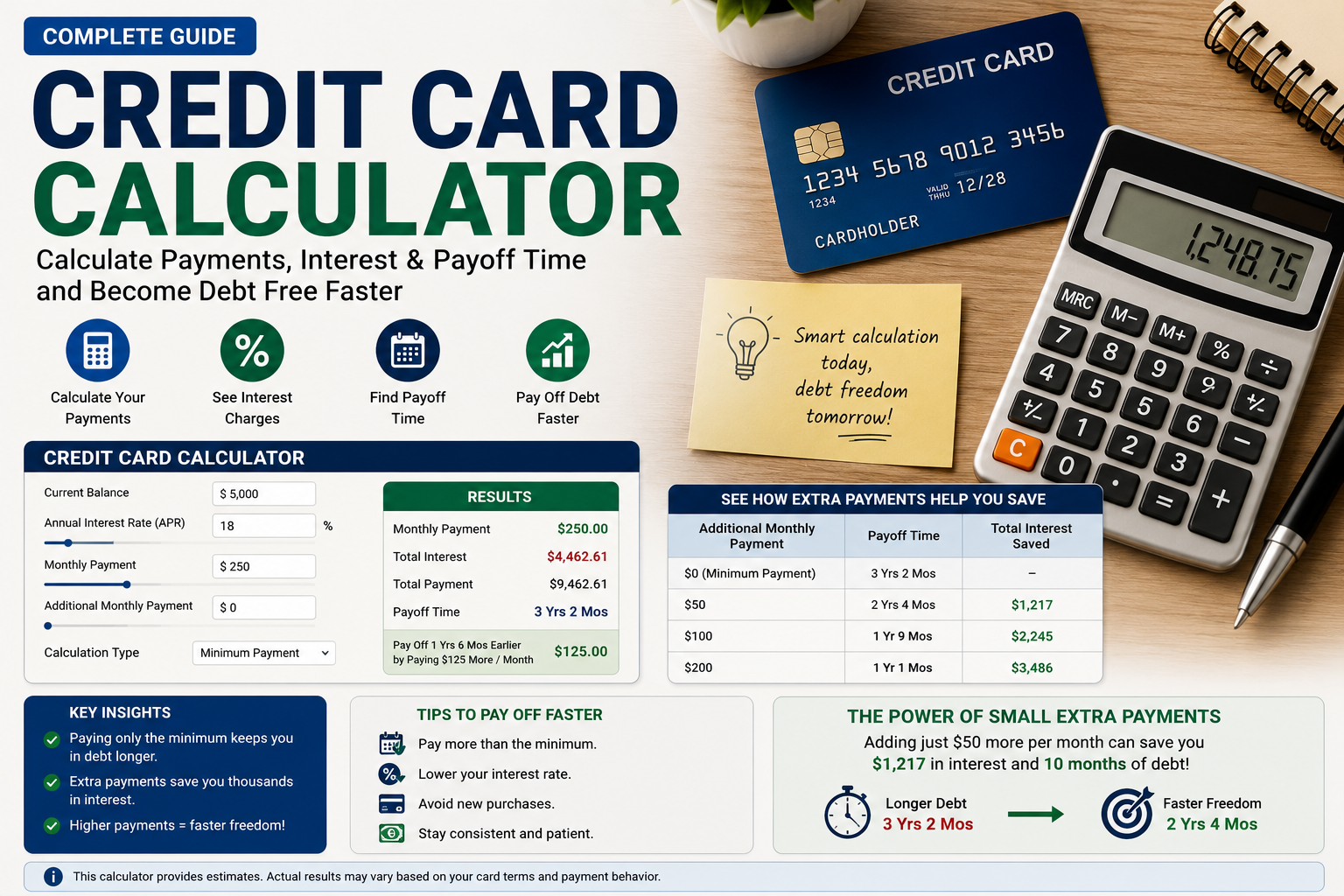
Credit card debt has a way of feeling manageable in the moment and overwhelming in hindsight. You make the minimum payment, the balance barely moves, and somehow a few years pass without much progress. A credit card calculator cuts through that fog by showing you, in hard numbers, exactly how long your debt will take to pay off and how much interest you’ll pay along the way if nothing changes. This guide walks through how to use one properly, what the numbers actually mean, and the specific mistakes that keep people stuck in minimum-payment cycles far longer than necessary.
What a Credit Card Calculator Actually Shows You
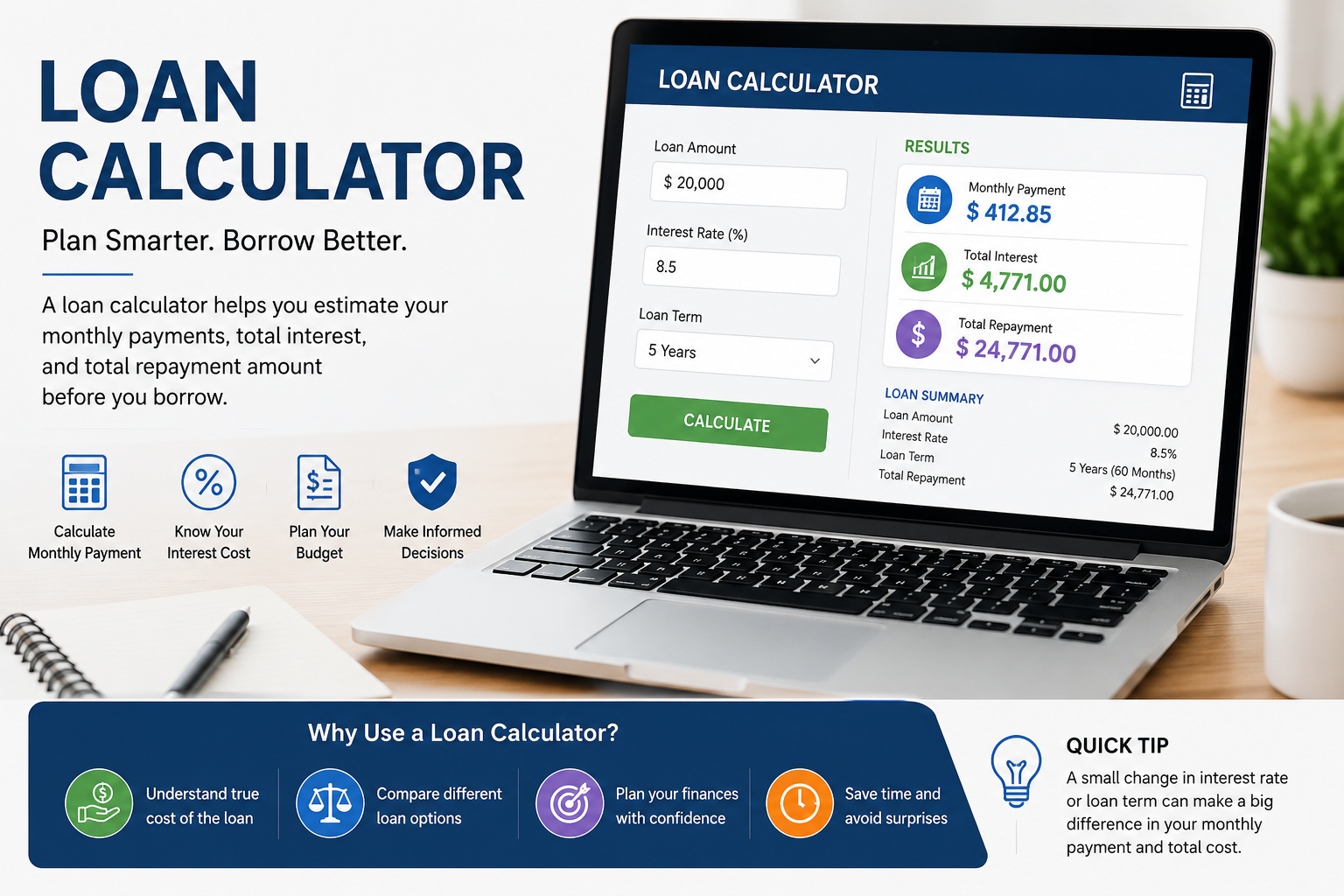
At its simplest, a credit card calculator takes your current balance, your interest rate, and your monthly payment, and projects forward how long it will take to pay off the debt and how much total interest you’ll pay. A good calculator goes further and shows you:
- How many months or years it will take to reach a zero balance at your current payment level
- The total interest you’ll pay over that period, separate from the principal you borrowed
- How increasing your monthly payment by even a modest amount changes both numbers
- A side-by-side comparison of minimum payments versus a fixed higher payment
That last point is where most of the real value sits. The gap between “minimum payment” and “a slightly higher fixed payment” is usually far larger than people expect, and seeing it laid out numerically tends to be the push people need to change their payment habits.
The Core Numbers You Need Before You Start
Before you run any calculation, gather these details from your most recent statement. Estimating instead of using your actual numbers will give you a misleading result.
1. Current Balance Use your actual current balance, not your credit limit and not a rounded guess. If you carry balances on multiple cards, it’s worth running each one separately, since rates and balances differ.
2. Annual Percentage Rate (APR) This is the interest rate applied to your balance, and it’s usually the single biggest factor in how much you’ll pay in total. Credit card APRs are often significantly higher than other forms of debt, which is exactly why a calculator is so useful here — the compounding effect at high rates is easy to underestimate.
3. Monthly Payment Amount This is the number you actually control. A calculator lets you test what happens at the minimum required payment versus a fixed higher amount, which is usually the most eye-opening part of the exercise.
4. Any Additional Charges If you’re still using the card while paying down the balance, factor that in. A calculator that only models a static balance with no new spending will understate your actual payoff timeline if you continue charging to the card.
How to Read Your Results the Right Way
Once you’ve entered your numbers, look past the payoff date and pay attention to these details:
- Total interest paid — This is often the most sobering figure in the entire exercise. On a high-rate card with only minimum payments, total interest can end up exceeding the original balance.
- Payoff timeline at minimum payments — Many people are surprised to learn that minimum-payment-only schedules can stretch into many years, even on what seemed like a modest balance.
- The impact of small payment increases — Test your numbers at your current payment, then again with an extra amount added. The reduction in both total time and total interest from even a modest increase is usually disproportionately large, which is the core insight a credit card calculator is built to reveal.
Common Mistakes People Make With Credit Card Calculators
Only ever checking the minimum payment scenario. If you never test a higher fixed payment, you never see how much time and money that change would actually save. Running both scenarios side by side is the whole point.
Ignoring the APR difference between cards. If you’re carrying balances on multiple cards, paying down the highest-rate card first — regardless of balance size — typically saves the most in total interest. A calculator makes this comparison concrete instead of theoretical.
Not accounting for continued spending. Paying down a balance while continuing to add new charges to the same card effectively resets the math. If this applies to you, run the calculation assuming no new charges, and treat that number as your realistic baseline for how much time is needed to actually make progress.
Overlooking balance transfer or consolidation options. A calculator won’t tell you whether a balance transfer card or a personal loan for consolidation makes sense for your situation, but it will show you the current cost of doing nothing — which is often the number that motivates people to look into those options.
Underestimating the value of an extra payment. Even a single extra payment a year, on top of your regular monthly amount, can meaningfully shorten a payoff timeline. Most calculators let you model this — it’s worth testing before assuming it isn’t worth the effort.
A Simple Step-by-Step Way to Use One
- Pull your current balance and APR from your most recent statement.
- Enter your current minimum payment and note the projected payoff time and total interest.
- Re-run the calculation with a higher fixed payment amount and compare both figures.
- If you carry multiple cards, repeat the process for each one separately.
- Decide whether continued spending on the card is realistic, and adjust your assumptions accordingly.
- Test the effect of one extra payment per year on your overall timeline.
- Use the comparison, not just one number, to set your actual monthly payment target going forward.
Final Thoughts
A credit card calculator turns an abstract, uncomfortable problem into a concrete plan. The real value isn’t the payoff date itself — it’s the comparison between what happens if nothing changes and what happens if you adjust your payment even slightly. Debt that feels permanent at a minimum payment often looks very different once you see, in actual numbers, what a modest increase would do to both the timeline and the total interest. Run your real numbers, test more than one scenario, and let the comparison guide the payment amount you commit to going forward.
best microfinance apps, top microfinance institutions, microfinance providers near me, best microloan apps 2026, microfinance banks list, microloan lenders, online lenders for small business, P2P lending platforms, peer to peer lending sites, women microfinance loans, women entrepreneurs loans, financial inclusion, unbanked population lending


ti1qm4