




Why Compound Interest Is the Most Powerful Force in Personal Finance
Albert Einstein reportedly called compound interest “the eighth wonder of the world” — and whether or not he actually said it, the math backs up the sentiment. Compound interest is the reason a modest, consistent investment can turn into a life-changing sum of money over time, and it’s the reason debt left unpaid can spiral out of control just as fast.
If you’ve ever wondered exactly how much your savings, investments, or loan balance will grow, a compound interest calculator removes the guesswork. In this guide, we’ll break down what compound interest actually is, how the formula works, walk through real examples, and show you how to use a calculator to plan your financial future with confidence.
What Is Compound Interest?
Compound interest is interest calculated on both the initial principal and the accumulated interest from previous periods. Unlike simple interest — which is only calculated on the original amount — compound interest builds on itself, creating exponential rather than linear growth.
Think of it this way: with simple interest, your money grows in a straight line. With compound interest, it grows in a curve that gets steeper the longer you let it run.
Simple Interest vs. Compound Interest
| Feature | Simple Interest | Compound Interest |
|---|---|---|
| Calculated on | Principal only | Principal + accumulated interest |
| Growth pattern | Linear | Exponential |
| Best for | Short-term loans | Long-term savings & investments |
| Long-term impact | Lower total return | Significantly higher total return |
The Compound Interest Formula
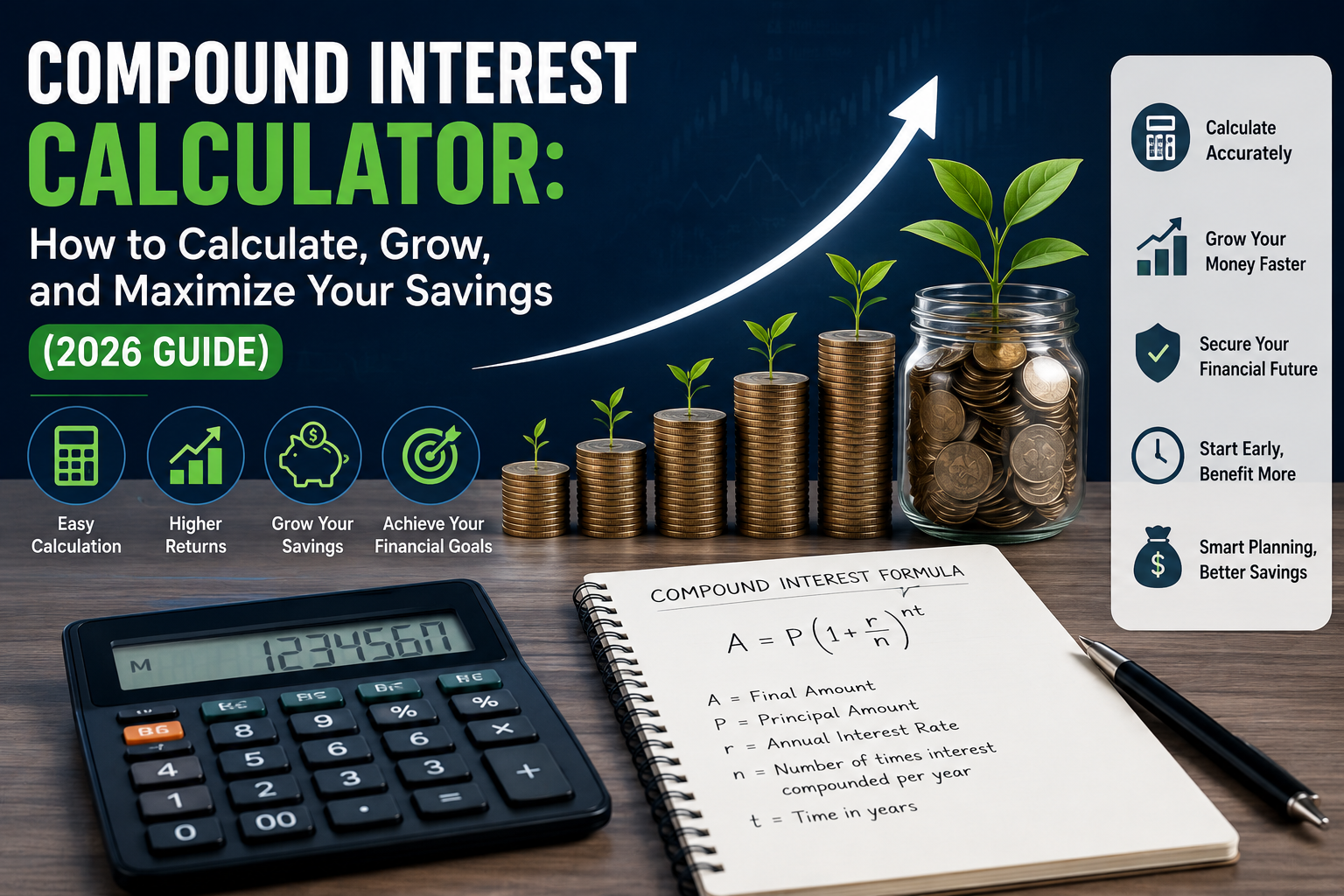
The standard compound interest formula is:
A = P (1 + r/n)^(nt)
Where:
- A = the future value of the investment (principal + interest)
- P = the principal amount (initial investment)
- r = annual interest rate (in decimal form)
- n = number of times interest compounds per year
- t = number of years
Example Calculation
Let’s say you invest $10,000 at an annual interest rate of 8%, compounded monthly, for 10 years.
- P = 10,000
- r = 0.08
- n = 12
- t = 10
A = 10,000 (1 + 0.08/12)^(12×10) = $22,196
That’s more than double your original investment — without adding a single extra dollar. This is the core reason financial advisors push clients to start investing early rather than waiting.
How Compounding Frequency Changes Your Results
One of the most overlooked variables in compound interest is how often the interest compounds. More frequent compounding means more growth, even at the same interest rate.
Using the same $10,000 principal at 8% for 10 years:
| Compounding Frequency | Future Value |
|---|---|
| Annually | $21,589 |
| Quarterly | $22,080 |
| Monthly | $22,196 |
| Daily | $22,253 |
The difference between annual and daily compounding might look small in percentage terms, but on larger sums over longer time horizons, it adds up to real money.
Why Use a Compound Interest Calculator Instead of Doing It Manually?
Calculating compound interest by hand is doable for a single scenario, but it becomes tedious and error-prone when you want to:
- Compare different interest rates side by side
- Test different compounding frequencies (daily, monthly, quarterly, yearly)
- Factor in regular monthly contributions on top of your initial deposit
- Plan for a specific financial goal (retirement, a home down payment, a child’s education)
A good online compound interest calculator does all of this instantly, letting you adjust variables and see results in real time — no spreadsheet formulas required.
What a Good Calculator Should Let You Input:
- Initial principal amount
- Annual interest rate
- Compounding frequency
- Time period (in years or months)
- Optional: recurring monthly contributions
Real-World Applications of Compound Interest
1. Retirement Savings
Retirement accounts are the textbook example of compounding at work. Someone who starts investing $300/month at age 25 will end up with significantly more at retirement than someone who starts investing $600/month at age 40 — purely because of the extra years of compounding.
2. Savings Accounts and Fixed Deposits
Banks and financial institutions use compound interest to calculate returns on savings accounts, certificates of deposit, and fixed deposits. Understanding the compounding frequency your bank uses can help you choose the account that actually earns you more.
3. Credit Card and Loan Debt
Compound interest isn’t just a wealth-building tool — it can work against you. Credit card debt compounds daily in many cases, which is why balances can balloon quickly if only minimum payments are made.
4. Business and Microfinance Growth
For entrepreneurs and small business owners — including those using microfinance tools to plan loan repayments or reinvestment strategies — compound interest calculations are essential for forecasting both debt obligations and reinvested profit growth.
Tips to Maximize the Power of Compound Interest
- Start early. Time is the single biggest lever in the compound interest formula. A few years’ head start can outweigh a much larger initial investment.
- Reinvest your returns. Withdrawing interest instead of letting it compound significantly slows growth.
- Contribute consistently. Regular monthly contributions, even small ones, dramatically increase your ending balance.
- Choose accounts with frequent compounding. Daily or monthly compounding will always outperform annual compounding at the same rate.
- Minimize high-interest debt. The same math that builds wealth can destroy it if you’re on the wrong side of the equation.
Frequently Asked Questions
1. What is a good example of compound interest? A savings account or index fund investment is a classic example. If you invest $5,000 at a 7% annual return compounded monthly for 20 years, it grows to roughly $20,240 — without adding any additional money.
2. How is compound interest different from APY? APY (Annual Percentage Yield) already factors in the effect of compounding over one year, expressed as a single rate. Compound interest is the underlying mechanism that produces that APY.
3. Does compound interest apply to loans? Yes. Many loans, especially credit cards and some personal loans, use compound interest, which means unpaid interest gets added to your balance and starts accruing interest itself.
4. What’s the “Rule of 72”? It’s a quick way to estimate how long it takes an investment to double: divide 72 by your annual interest rate. At 8% interest, your money doubles in approximately 9 years (72 ÷ 8 = 9).
5. Is daily compounding always better? Daily compounding produces marginally higher returns than monthly or annual compounding at the same nominal rate, but the difference is usually small unless you’re dealing with large sums over long periods.
Final Thoughts
Compound interest is simple in concept but powerful in effect — and the earlier you understand and apply it, the more it works in your favor. Whether you’re saving for retirement, evaluating a loan, or planning a business investment, running the numbers through a compound interest calculator takes the guesswork out of long-term financial planning.
Try adjusting the principal, rate, and time period in the calculator above to see exactly how your money can grow — and start putting compound interest to work for you today.
Disclaimer: This article is for informational purposes only and does not constitute financial advice. Consult a licensed financial advisor for guidance specific to your situation.
Compound Interest Calculator
Calculate your investment growth instantly with monthly deposits, multiple currencies and compound interest.
Investment Details
Investment Summary
Total Investment
$0.00
Interest Earned
$0.00
Future Value
$0.00
Total Return
0%
Yearly Investment Growth
| Year | Opening Balance | Contribution | Interest | Closing Balance |
|---|
Investment Growth Chart
Compound Interest Formula
A = P (1 + r / n)nt
- A = Future Value
- P = Initial Investment
- r = Annual Interest Rate
- n = Compounding Frequency
- t = Time in Years
What Is Compound Interest?
Compound interest is the interest earned on both your original investment and the interest accumulated over time. This allows your money to grow faster than simple interest.
Why Use This Calculator?
- Instant calculations
- Supports monthly contributions
- Multiple currencies
- Professional investment planning
- Free to use
Benefits of Compound Interest
- Grow wealth faster
- Earn interest on interest
- Perfect for long-term investing
- Ideal for retirement planning
- Works with regular monthly deposits
Frequently Asked Questions
What is compound interest?
Compound interest means your investment earns interest on both the original amount and the accumulated interest.
How often should interest be compounded?
Monthly compounding is the most common option, but daily compounding usually produces slightly higher returns.
Can I add monthly deposits?
Yes. This calculator allows optional monthly contributions to estimate future investment growth more accurately.
Is this calculator free?
Yes. It is completely free and available for everyone.




One thought on “Compound Interest Calculator: How to Calculate, Grow, and Maximize Your Savings (2026 Guide)”