







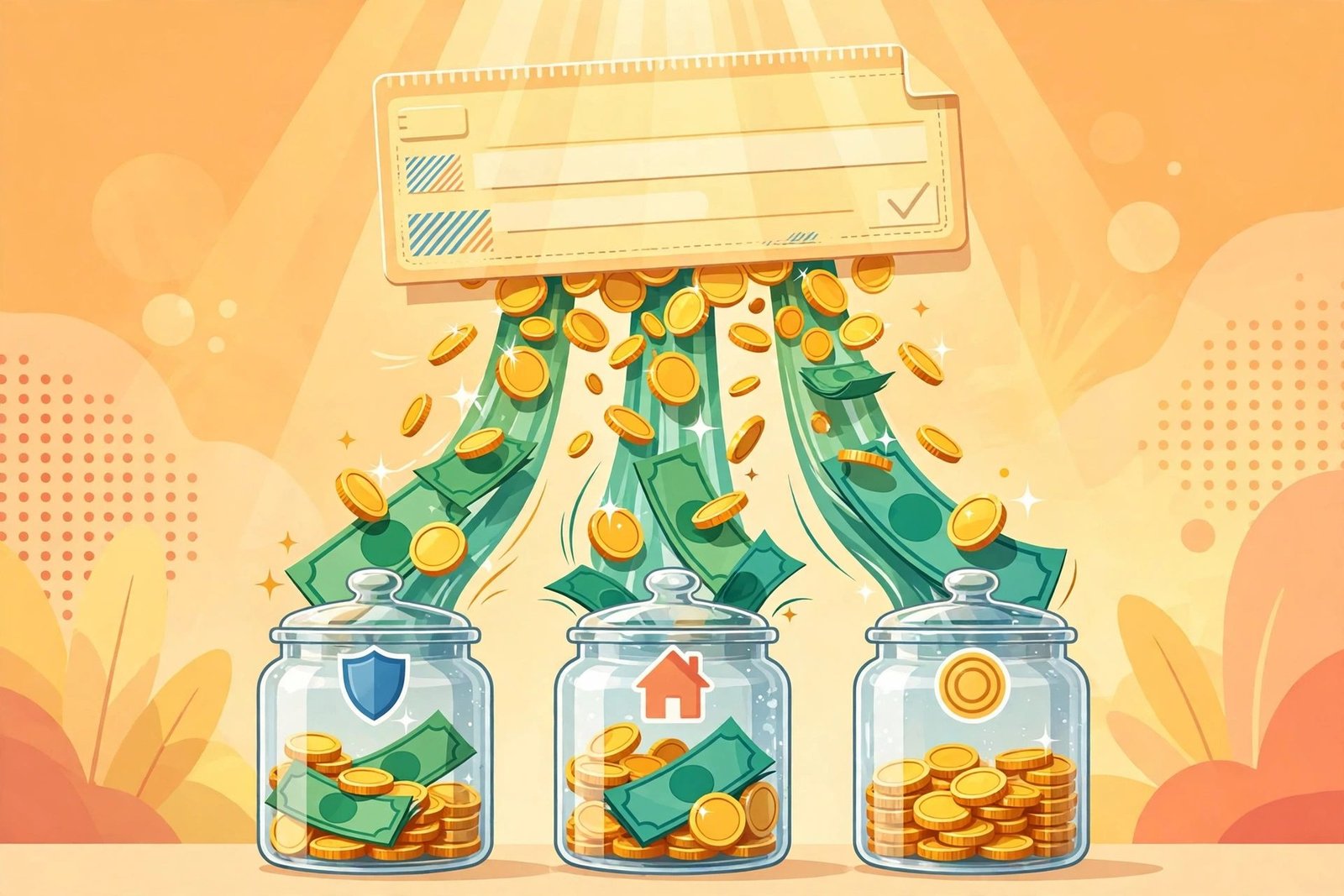
The pay yourself first method means moving a set amount of money into savings the moment your paycheck lands — before rent, groceries, or anything else. You treat savings like a bill you owe yourself, then live on what is left. It is also called reverse budgeting, and it works because saving becomes automatic instead of optional.
Most of us have tried it the other way round — pay every bill, then save whatever is left — and the month always ends with nothing left. That is not a willpower problem. It is a design problem.
What Is the Pay Yourself First Method?
The pay yourself first method flips the usual order of money. In a traditional budget, the formula is income minus expenses equals savings. In reverse budgeting, it is income minus savings equals expenses. The savings line comes first, every single payday, and everything else is budgeted from what remains.
Take a $3,500 monthly take-home pay: on payday, $350 moves automatically into savings before you see it, leaving $3,150 for everything else. The $350 sits safely out of reach. Three things make it work: the amount is decided in advance, the transfer is automatic, and the money lands in a separate account, so a casual impulse cannot undo it in one tap.
Why Saving Last Almost Never Works
How often has “whatever is left” actually turned into savings? Almost never. The US personal saving rate sat at just 4.6% of disposable income in 2024, and the Federal Reserve found roughly 37% of US adults could not cover a $400 emergency with cash alone.
The reason is present bias: we naturally value spending today over saving for tomorrow. When savings sit at the bottom of the list, every small decision in the month gets a vote first — the takeaway, the sale, the surprise bill — and by the 30th there is nothing left. Automation removes the vote entirely. Vanguard found workers automatically enrolled in 401(k) plans saved at 12.1%, versus just 7.6% for workers who enrolled voluntarily. Same jobs, same pay — the only difference was the default.
The Payday Waterfall: Where Your Money Should Go First
Paying yourself first is not just about moving money — it is about sending it to the right place in the right order. Think of it as a waterfall, where each level fills before the next one gets a drop.
Level 1: Grab the full employer 401(k) match. That match is free money. Contribute at least enough to get it before saving anywhere else.
Level 2: Build a $1,000 starter emergency fund. This buffer stops the flat tyre or broken boiler landing on a credit card — keep it in a separate high-yield savings account.
Level 3: Attack high-interest debt. Card debt at around 21% APR while savings earn 4–5% loses roughly 16 points a year. Keep automatic savings small while you clear the card.
Level 4: Grow the emergency fund to 3–6 months of expenses. Once the debt is gone, the waterfall flows here until the fund is full.
Level 5: Feed retirement accounts. With the match captured, the fund built and the debt cleared, extra savings go to an IRA or higher 401(k) contributions.
Here is what 10%, 15% and 20% look like at three take-home pay levels:
- $2,500 a month: 10% = $250, 15% = $375, 20% = $500 ($3,000 a year at 10%).
- $3,500 a month: 10% = $350, 15% = $525, 20% = $700 ($6,300 a year at 15%).
- $5,000 a month: 10% = $500, 15% = $750, 20% = $1,000 ($12,000 a year at 20%).
Do not obsess over the perfect percentage: 10% saved reliably beats 30% saved in bursts. Start where you can keep it, then raise it by 1% with every pay rise.
How to Set It Up in About an Hour
First, work out your real take-home pay, then list your fixed non-negotiables: rent or mortgage, minimum debt payments, utilities, insurance. Subtract them from your pay — what is left is genuinely flexible, and your savings amount must fit inside it with the bills still covered.
Next, open a separate savings account, ideally at a different bank — a one- or two-day transfer delay stops most impulse withdrawals — and name it for its job, like “Emergency fund”. Then choose how the money moves. The gold standard is a split direct deposit: payroll sends a fixed amount of each paycheck straight to savings, so the money never touches checking. If your employer does not offer that, schedule a recurring transfer for the day after payday. Either way, the decision is made once — then set a six-month reminder to bump the amount by 1%.
When Pay Yourself First Does Not Work
High-interest debt is the clearest exception: if your card charges around 21% APR while savings earn 4–5%, clear the card first — keep a small $25-a-paycheck transfer alive so the habit survives, and throw the rest at the debt.
Freelancers face a different problem: a fixed transfer can leave rent short in a slow month. Save a percentage of every deposit instead — a 10% sweep on every payment keeps the structure without the overdraft risk. And if your bills already swallow your whole paycheck, even $25 per paycheck builds the habit.
FAQs
What does the pay yourself first method mean?
The pay yourself first method means moving a set amount of money into savings the moment your paycheck arrives, before paying bills or spending on anything else. Savings becomes a fixed bill you owe yourself, and you live on whatever remains.
How much should I pay myself first?
A common starting target is 10% of take-home pay, rising toward 20% as your income grows. On $3,500 a month, 10% is $350, or $175 per paycheck. If 10% would leave rent short, start at 5% or $25 a paycheck and raise it by 1% every few months.
Should I pay myself first if I have credit card debt?
Yes, but keep the automatic savings small at first. Save toward a $1,000 starter emergency fund so the next surprise does not go on the card, and send most of your extra money to the high-interest debt. Once the card is paid off, raise the savings amount.
Does my 401(k) count as paying myself first?
Yes, a 401(k) contribution counts as paying yourself first because it comes out of your pay before the money reaches your bank account. At minimum, contribute enough to capture your employer’s full match. You still need cash savings for emergencies, since 401(k) money cannot usually be withdrawn early without penalties.
How do I automate the pay yourself first method?
Ask your employer to split your direct deposit so a fixed amount of each paycheck goes straight to a separate savings account. If split deposit is not available, schedule a recurring transfer from checking to savings for the day after each payday. Keep that account at a different bank.
The pay yourself first method is not complicated, and that is exactly why it works. Decide once, automate it, and let payday do the saving for you. Start small, set the transfer for the day after payday, and raise it by 1% whenever your pay rises.