






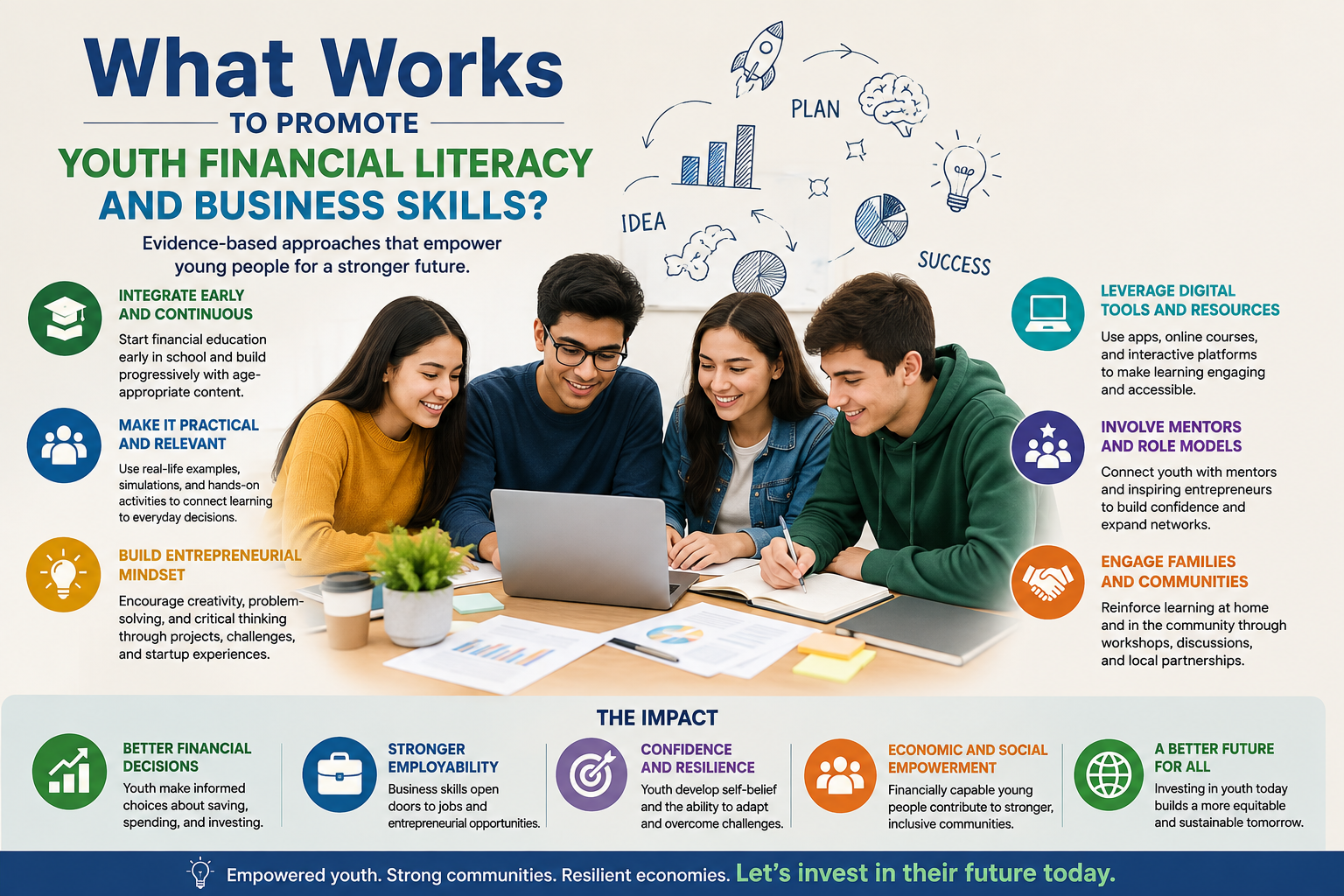
Meta description: What actually works in youth financial literacy and business education and Business Skills? — backed by research from Brookings, CFPB, and J-PAL. A practical, evidence-based breakdown.
Every few years, a new financial literacy curriculum, app, or classroom program launches with the same promise: teach kids about money early, and they’ll make better decisions for life. It’s an intuitive idea. It’s also only partly true.
Decades of research into youth financial literacy programs — from school-based curricula to community workshops to hands-on entrepreneurship simulations — have produced a more complicated picture. Some approaches move the needle. Others look good on paper but barely change real behavior. If you’re a parent, educator, program designer, or fintech founder building for this space, the difference matters in Business Skills?
Quick Overview: What the Evidence Actually Shows
- Knowledge alone rarely changes behavior — test scores go up, but spending and saving habits often don’t follow
- Timing matters more than content — lessons taught right before a real financial decision stick better than lessons taught years in advance
- Hands-on simulation beats lecture-style teaching — programs like real-budget exercises outperform classroom-only instruction
- Access to a savings account changes outcomes — pairing education with an actual financial product (not just theory) improves results
- Teacher training is a weak link — most educators get little to no support to teach financial literacy well
- Equity gaps persist — Black, Hispanic, and female students are statistically less likely to have access to quality financial literacy programs
Why This Question Is Harder Than It Sounds
Financial literacy is often measured the same way as a school subject — through a test. A student learns about compound interest, gets quizzed, and if they answer correctly, the program is deemed “successful.”
The problem is that knowing a concept and applying it under real financial pressure — a car breaking down, a first paycheck, a credit card offer — are two different skills entirely. Research reviewing large-scale youth financial literacy efforts has repeatedly found a gap between short-term knowledge gains and long-term behavior change. A teenager can ace a budgeting quiz in April and still overspend their first paycheck in June.
This is the core challenge behind the question “what works”: it’s not really about which curriculum is best. It’s about which delivery methods translate into decisions young people actually make later.
What Tends to Work
1. Teaching at the “Teachable Moment”
Programs that deliver financial education right before a relevant decision — opening a first bank account, applying for a student loan, starting a first job — consistently outperform generalized lessons taught years earlier with no immediate application. The lesson sticks because it’s immediately useful, not abstract.
2. Experiential and Simulation-Based Learning
Reading about budgets is forgettable. Managing one — even a fake one — is not. Programs like Junior Achievement’s JA Finance Park put students through a real-world simulation where they allocate a set income across groceries, housing, transportation, and other necessities. This kind of hands-on exercise consistently shows up as more effective than lecture-based instruction, because it forces trade-off decisions rather than passive absorption of facts of Business Skills?
3. Pairing Education With Access
Financial literacy training works better when it’s connected to an actual financial product. Encouraging a teenager to open a savings account — and then teaching them about interest and deposits using their own account — builds understanding that pure classroom theory can’t replicate. Education without access to tools to apply it tends to fade quickly.
4. Community and Family Reinforcement
Financial habits don’t form solely in a classroom. Parents who model responsible financial behavior — budgeting, saving consistently, avoiding impulsive debt — pass those habits on far more effectively than any single school unit can. The most durable programs treat families and community organizations as partners, not bystanders, reinforcing lessons outside the classroom.
5. Gamification and Interactive Tools
Apps, workshops, and interactive platforms that turn financial concepts into decision-based challenges — rather than static information — tend to hold youth attention longer and translate into better engagement with the material. This doesn’t replace structured curriculum, but it does make repeated exposure more likely, which matters given how much financial habits depend on reinforcement over time.
What Tends to Fall Short
- One-off lectures or assemblies with no follow-up or application rarely move behavior, even when they score well on immediate quizzes
- Generic, one-size-fits-all curricula that ignore that financial literacy needs differ meaningfully by income level, access to banking, and family financial stability
- Programs with no evaluation structure — without pre/post measurement or long-term tracking, it’s genuinely unknown whether many popular programs work at all
- Teacher-led instruction with no training support — many educators are asked to teach financial literacy with minimal preparation, which limits how well even a strong curriculum gets delivered
The Equity Gap Nobody Talks About Enough
Access to quality financial literacy education isn’t distributed evenly. Research has found that students who are Black, Hispanic, or female are statistically less likely to have access to structured financial literacy training — a gap that compounds existing disparities in wealth-building over a lifetime. Any program claiming to “promote youth financial literacy” without accounting for this access gap is solving only part of the problem.
This matters especially for organizations building fintech tools, educational platforms, or community programs aimed at underserved populations — the design question isn’t just “does this teach financial concepts,” but “who actually gets to use it.”
Building Business Skills Alongside Financial Literacy
Financial literacy and entrepreneurship education increasingly overlap, and the evidence here reinforces the same pattern. Young people learning to start or run a business need more than budgeting basics — they need:
- Cash-flow management specific to running a venture, not just a household
- Risk assessment tied to real business decisions, not hypothetical scenarios
- Basic accounting and record-keeping habits built early, not retrofitted later
- Exposure to real market conditions, ideally through mentorship or simulation rather than theory alone
Systematic reviews of financial literacy in student entrepreneurship consistently point to the same conclusion as the broader financial literacy research: students with structured, applied financial training make fewer costly mistakes and build more resilient ventures than those without it.
The Bottom Line
“What works” in youth financial literacy isn’t a single curriculum, app, or classroom hour — it’s a combination of timing, hands-on application, real financial access, family reinforcement, and honest evaluation of results. Programs that check only one or two of these boxes tend to produce test-score improvements that don’t survive contact with real financial decisions.
For educators, parents, and organizations building in this space, the actionable takeaway is simple: don’t ask “did students learn the concept?” Ask “will students actually use it — and did we build the program to make sure they can?”
FAQ
1. Does teaching kids about money actually change their financial behavior?
Not on its own. Knowledge-based programs often raise test scores, but that doesn’t reliably translate into better saving or spending habits. Behavior change requires more than information — it needs timing, practice, and real-world application.
2. When is the best time to teach financial literacy to youth?
Right before they face a real financial decision — opening a first bank account, taking a student loan, or starting a first job. Lessons taught years in advance, with no immediate use, tend not to stick.
3. Is classroom-based teaching enough, or do kids need hands-on practice?
Hands-on simulation consistently outperforms lecture-style teaching. Programs that have students manage a real or simulated budget — allocating income across housing, food, and other costs — build understanding that passive listening doesn’t.
4. Does it help to pair financial education with an actual bank account or financial product?
Yes. Teaching concepts like interest and deposits using a student’s own savings account produces better results than theory alone. Access to a real financial tool reinforces the lesson.
5. How much do parents and family influence a child’s financial habits?
Significantly. Kids absorb financial behavior — budgeting, saving, avoiding impulsive debt — more from watching parents model it than from any single classroom unit. Programs that involve family and community tend to be more durable.
6. Are financial literacy apps and gamified tools effective?
They help with engagement and repeated exposure, which matters since financial habits build over time. But gamification supports a structured curriculum — it doesn’t replace one.
7. Is financial literacy education equally accessible to all youth?
No. Research shows Black, Hispanic, and female students are statistically less likely to have access to quality financial literacy programs — a gap that widens existing wealth-building disparities over time.
8. What’s different about teaching business skills versus general financial literacy?
Business-focused learners need more than budgeting basics: cash-flow management for a venture (not a household), risk assessment tied to real decisions, early accounting habits, and exposure to real market conditions through mentorship or simulation.
9. Why do some well-funded financial literacy programs still fail to show results?
Mainly two reasons: little to no evaluation structure (so nobody actually measures long-term impact), and teachers who are asked to deliver the curriculum with minimal training support.
SBP microfinance guidelines, State Bank microfinance rules, financial literacy tools, savings groups, rotating savings and credit association, informal lending, moneylender vs microfinance, shadow banking, subprime lending, alternative lending, non-bank financial institution, NBFI lending, startup funding options, bootstrapping vs microloan

Bài viết hay, mình học được nhiều điều. Letco là địa chỉ du học Hàn Quốc đáng tin cậy, hỗ trợ toàn diện từ tiếng Hàn đến visa. Xem tại letco.vn.